The pattern almost every trader knows
You start with good intentions. Day one, you write a full breakdown of your trade — entry, exit, reasoning, screenshots. Day two, a shorter version. By day ten, you're telling yourself "I'll fill it in later." By week two, the journal is a half-empty spreadsheet you've stopped opening.
If this sounds familiar, you're not undisciplined — you're describing one of the most common patterns in trading. Almost every trader who's ever tried to journal has lived some version of this exact timeline. The question worth asking isn't "why can't I stick with this," it's "why does this specific habit die so predictably, for almost everyone?"
The real reasons people quit
Journaling doesn't fail because traders are lazy. It fails for a handful of specific, fixable reasons:
- Friction. Manual entry after every single trade feels like homework — and it's worst exactly when motivation is lowest: after a losing day, when the last thing you want to do is relive it in writing.
- No immediate payoff. A journal's real value only shows up after weeks or months of accumulated data, once patterns start to emerge. In the short term, skipping today's entry feels harmless. That short-term logic wins, day after day, until the habit is gone.
- Shame avoidance. Writing down a bad trade means confronting the mistake in black and white. It's psychologically easier to just close the tab and move on than to sit with "I moved my stop loss again."
- The wrong tool for the habit. Spreadsheets and notebooks require you to remember to open them, remember what happened, and have the discipline to write it all out from scratch, every time. Most habit failures aren't willpower failures — they're tooling failures. A habit that depends on remembering and composing from a blank page is a habit designed to be skipped.
Why it's worth pushing through
Here's the short version, since this part is well-trodden ground: pattern recognition is invisible without a written record. You might sense you trade worse late at night, or after a loss, or on a particular pair — but "sense" isn't the same as knowing. A journal is what turns a vague hunch into a fact you can actually act on. The traders who improve fastest aren't the ones who trade the most; they're the ones who can actually see what they're doing.
The point of this post isn't to convince you journaling matters — you already know that, or you wouldn't have started in the first place. The point is fixing the part that actually breaks: sticking with it.
How to actually stick with it
None of this is about willpower. It's about removing the specific points of friction identified above.
-
01Automate the data entry entirely The single highest-leverage fix. If your trades — entry, exit, size, P&L — log themselves automatically from your MT5 terminal, the "remembering to write it down" failure point disappears completely. There's nothing to forget, because there's nothing manual left to do.
-
02Use structure instead of a blank page One of the biggest silent killers of journaling is staring at an empty text box, not knowing what to write. A short set of fixed prompts — what was the setup reason, what was your emotional state, what mistake (if any) did you make — turns journaling into filling in blanks instead of composing an essay from scratch.
-
03Make "did I follow my plan" a single checkbox The fastest, lowest-friction form of self-accountability is a yes/no tick, not a paragraph justifying your reasoning. Save the writing for the trades that actually need it.
-
04Journal the loss especially, not just the wins Reframe a losing trade as data, not confession. The losses are where almost all the useful pattern information lives — skipping them is skipping the part of the journal that actually improves you.
-
05Review weekly, not daily Daily review is where most people burn out — it's simply too frequent to sustain alongside actually trading. A weekly review is enough to catch patterns and is genuinely sustainable long-term.
-
06Make review visual, not just numbers A calendar heatmap or equity curve is far easier to stick with than scrolling through rows of a trade log. Visual review takes seconds and still tells you what you need to know.
-
07Track your completion rate as its own motivator Seeing something like "1 journaled, 425 pending, 0% complete" is uncomfortable — in a useful way. It turns journaling into a visible, trackable habit instead of an invisible task that's easy to quietly abandon. The same psychology that makes habit-streak apps work applies here.
-
08Lower the bar One honest line of reflection beats a full essay you never end up writing. Consistency beats depth, every time, especially in the first few months of building the habit.
Why YourTradeBook is built differently
Most of the friction points above aren't accidental gaps in most trading journals — they're the direct result of how those tools are built. YourTradeBook (YTB) was designed specifically around removing them, not adding more features on top of the same broken workflow:
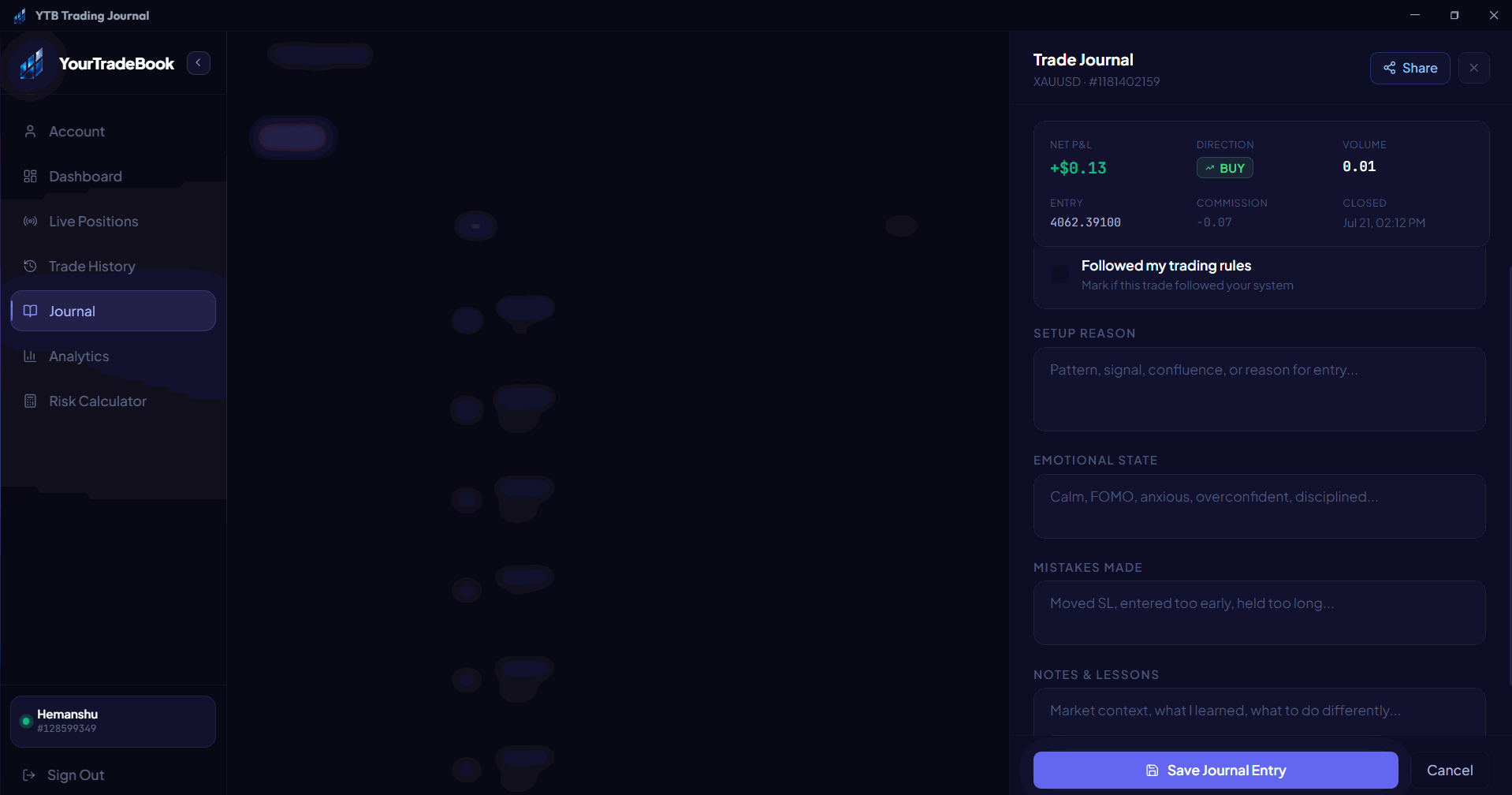
Structured prompts instead of a blank page — and a single checkbox for plan adherence, not a paragraph.
Every trade already arrives pre-filled with the entry, exit, volume, and P&L — synced live from MT5, nothing typed in manually. What's left for you to do is intentionally small: a short prompt for setup reason, one for emotional state, one for mistakes made, and a single checkbox for whether you followed your own plan. That's the entire manual step. No blank page, no remembering, no composing from scratch.
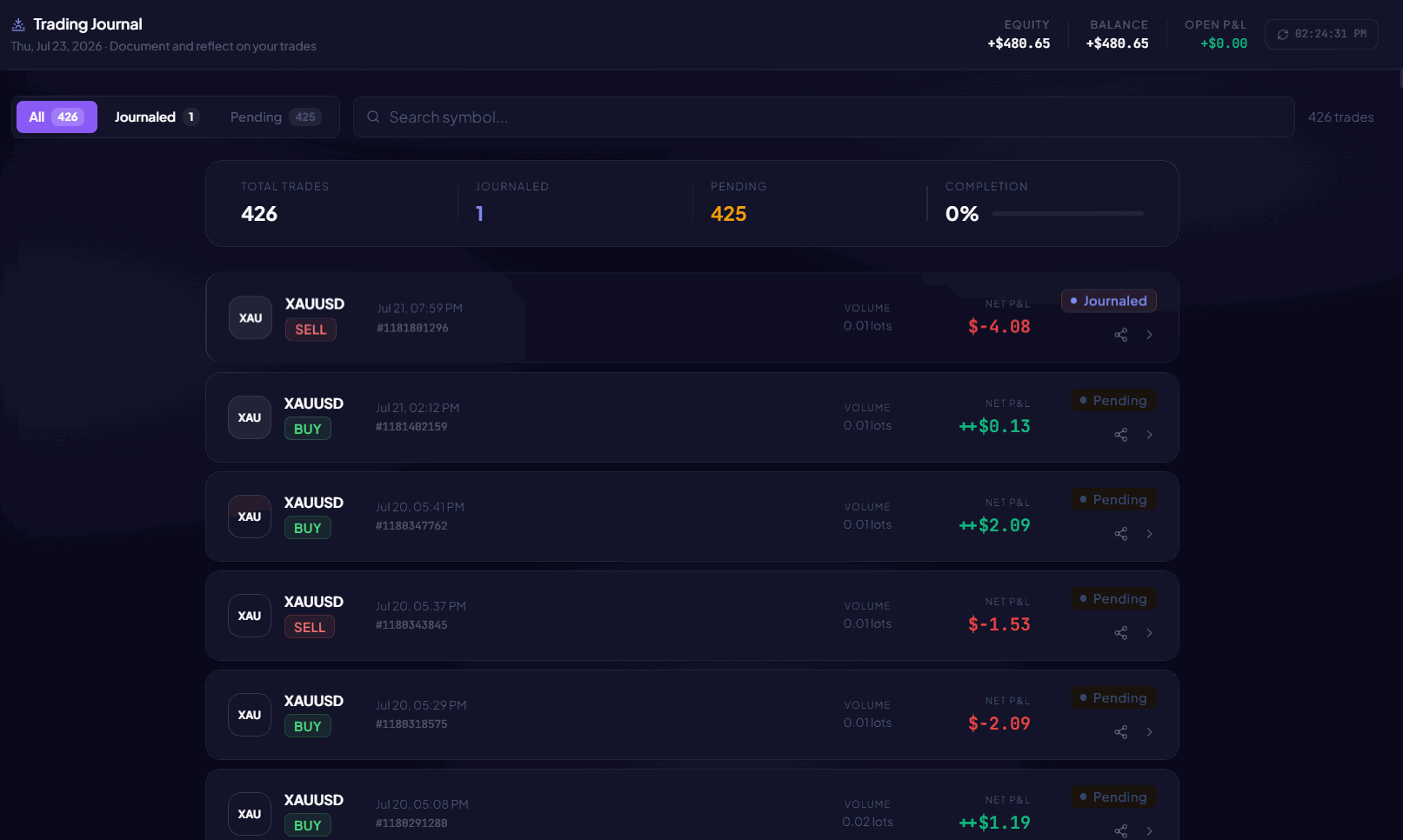
A visible completion rate — journaled vs. pending — turns the habit into something trackable, not invisible.
Every trade shows up as either Journaled or Pending, with a running completion percentage right at the top. It's a small design choice, but it changes the psychology entirely — instead of journaling being an invisible task you can quietly stop doing, it becomes a visible number that's uncomfortable to leave incomplete, the same mechanism that makes habit-tracking apps actually work.
Combined with automatic MT5 sync, a weekly-friendly equity curve and calendar heatmap for visual review, and the fact that none of this data ever leaves your own PC — YTB isn't just "a journal with more features." It's built around the specific, well-understood reasons journaling habits die, not just around adding more fields to fill in. One-time payment, no subscription, and the entire point is that you actually keep using it past week two. If privacy and offline data are a priority for you, it's worth reading more on why an offline trading journal matters in 2026.
Frequently asked questions
How long should a trading journal entry take?
With automatic sync and structured prompts, well under a minute per trade. If an entry is taking you several minutes, the tool is asking for too much — that's usually what causes people to quit.
Should I journal winning trades too, or just losses?
Both, but don't feel obligated to write as much on wins. Losses tend to carry more useful pattern information, but wins are still worth a quick note — especially to confirm you're winning for the reason you think you are.
What's the easiest way to journal MT5 trades specifically?
Automatic sync from your MT5 terminal removes the biggest point of failure — manual entry. Tools like YourTradeBook pull trade data directly from MT5 so there's nothing to type in after each trade.
Is a 0% completion rate a bad sign?
Not if you're just getting started — it's simply a starting point. The point of tracking it isn't guilt, it's visibility. A number you can see is a number you're more likely to actually move.
Final thoughts
Journaling doesn't fail because traders lack discipline. It fails because most journals are built in a way that makes quitting the path of least resistance — manual entry, blank pages, no visible progress. Fix the friction, and the habit tends to take care of itself.
If you're currently trading toward a funded account, a consistent journal matters even more, since it's often the difference between passing and failing. See our guide on how to pass a prop firm challenge in 2026 for more.